


On April 17, the Casa de Chocolate in Ourense hosted the roundtable talk “Wars for Oil and Possible Transitions: Agrarian Regeneration of the Territory”, as part of the NonNormal initiative, developed between April 13 and 19 in different locations across Spain to open a debate on the energy crisis, geopolitical tensions, and the limits of the current model. The talk was given by Quico Ónega, a member of the Land Lab (Laboratorio do Territorio) of the University of Santiago de Compostela.
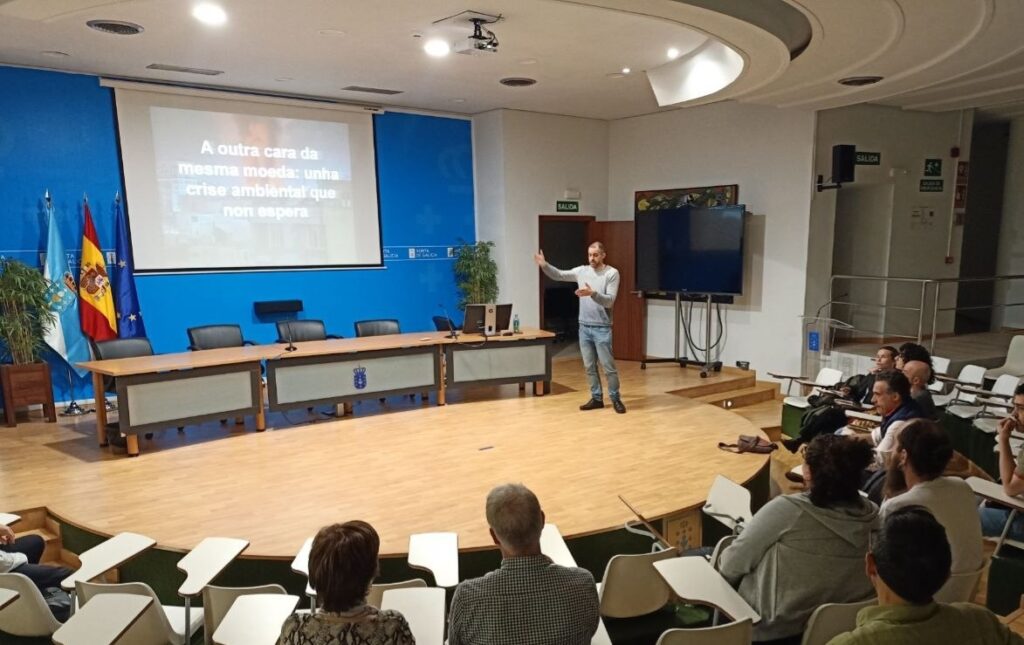
The NonNormal Tour is a space for dissemination, reflection, and mobilization around the energy crisis, the material limits of industrial civilization, and the awareness that the recent economic and social model has never been truly sustainable, nor will it be.
The presentation started from the general diagnosis put forward by NoNormal, focused on the massive dependence of the current model of production and consumption on fossil fuels, the vulnerability of the global system, and the impossibility of a transition based on technological substitution alone. At this point, it is necessary to fundamentally change the current model and replace it with one grounded in social justice and the material reality of a finite planet.
Within this framework, the talk offered a specific reading of the Galician case, focusing on transformations in the rural territory and on recent developments in the agrarian sector and land use. Issues addressed included the loss of agrarian land base, land abandonment and afforestation, livestock intensification, and the growing dependence on feed, fertilizers, machinery, and imported inputs of all kinds, linking the global energy crisis diagnosis with Galicia’s territorial dynamics and highlighting the vulnerability of the current agri-food model.
The presentation examined the so-called “paradox of the Galician agri-food model”: Galicia is losing agrarian land while simultaneously intensifying livestock farming; it reduces its own usable agricultural area while increasing its dependence on imported feed, fertilizers, and other inputs; and at the same time it fails to produce enough basic food for its population (just over 10% of the cereal for human consumption), indirectly “importing” a cultivated area 150% larger than its own cultivated land.
As a forward-looking approach, the talk pointed to the agroecological regeneration of the territory as a pathway towards more resilient food systems, based on the recovery of agrarian land, productive diversification, protection of essential natural resources, and the reconnection between agriculture, society, and territory within the framework of agroecology.